

Wall lights either side of a fireplace or TV work best as a matched pair, mounted with the centre of each fitting 150 to 170 cm off the floor and 15 to 30 cm out from the edge of the TV, mirror or fireplace surround. Use warm white globes (2700K to 3000K) and give the pair its own switch.
That covers most rooms. The trouble starts with the details: a chimney breast that sticks out, a mantel at an odd height, a TV that reflects everything, or a wall that turns out to be solid brick. Those are the questions people keep asking on renovation forums, so here they are one at a time.
Should the lights go on the chimney breast or in the alcoves?
On the chimney breast itself, if it is at least 40 cm wider than the TV or mirror on it. That leaves room for a fitting on each side without it looking squeezed against the corner.
When the breast is narrow, move the lights to the back wall of each alcove instead. You get the same symmetry, the fittings stop competing with the TV, and the alcoves (which are usually the darkest part of the room) finally get some light. If you have shelving built into the alcoves, mount the lights above the top shelf or on the face of the joinery, not hidden behind it.
The option to avoid is the short side return of the chimney breast, the narrow strip that faces sideways into each alcove. It sounds clever. In practice the light fires across the alcove at a strange angle, the bump-out throws a hard shadow onto the main wall, and from the sofa you only ever see one of the pair properly.
| Where | Works when | Watch out for |
|---|---|---|
| On the chimney breast, beside the TV or mirror | The breast is 40 cm or more wider than what hangs on it | Masonry behind the plaster, objects on the mantel casting shadows |
| Back wall of each alcove | The breast is narrow or the TV fills it | Shelving that blocks the light, unequal alcove widths |
| Side returns of the chimney breast | Rarely the best answer | Hard shadows on the main wall, lopsided look from the sofa |
| Flat media wall with no fireplace | Always an option | Fittings too close to the screen edge |
How high should wall lights be beside a fireplace?
Aim for the centre of each fitting at 150 to 170 cm from the floor, then check it against the mantel. The bottom of the fitting should sit clear of the mantel shelf, so candles, vases or a clock on the shelf do not cast shadows straight up the wall.
A mirror or artwork over the fireplace changes the reference point. Line the fittings up roughly a third of the way down from the top of the frame. Hung lower than that, they look like they have slid down the wall. Hung level with the top edge, they fight the frame for attention.
For rooms with tall ceilings, go towards the top of the range or slightly above. Our room-by-room height guide has the full set of numbers.
How far apart should wall lights be either side of a TV?
Measure from the edge of the screen, not from the centre of the wall. Leave 15 to 30 cm between the side of the TV and the nearest edge of each fitting.
Closer than 15 cm and the fittings read as part of the TV, which makes a 65 inch screen look even bigger. Much further than 30 cm and they drift away from it and stop framing anything. On a big media wall with no fireplace, the screen sets the spacing and the room is less fussy.
One more check before anyone drills: stand in the doorway and look. A fitting that is 2 cm out of line with its partner is surprisingly easy to spot from across the room.

Will wall lights cause glare on the TV?
Not if they are on the same wall as the TV. A screen reflects what is in front of it, so the light that bounces back into your eyes comes from the wall behind the sofa or from a window opposite. Fittings mounted beside the screen sit outside that reflection.
They also help. Watching a bright screen in a pitch dark room means your eyes keep adjusting between the picture and the black wall around it. A soft glow either side of the TV takes the edge off that, and it stops a switched-off screen being a big black rectangle in the middle of the room.
What does cause glare is a bare, bright globe pointing into the room. Pick fittings where the light source is hidden: a diffused disc, a stone shade, or an up and down light that throws light along the wall rather than out at the viewer. The travertine Strata casts light up and down for exactly this reason, and the guide to up and down wall lights explains why that beam shape flatters a wall. Keep the globes warm white, 2700K to 3000K, because cooler light beside a screen makes the room feel like an office. The warm white vs cool white guide goes through why.
Can you put wall lights on a brick chimney breast?
Yes, but it is more work than a plasterboard wall. A licensed electrician has to install any hardwired wall light in Australia under the AS/NZS 3000 wiring rules, and on solid masonry that usually means chasing a channel for the cable or running it in surface conduit.
A few things to raise with your electrician before you buy:
- Whether the chimney breast is solid brick, hollow, or a plasterboard box built around a flue.
- Whether the cable can come down from the ceiling inside the alcoves instead, which is often simpler.
- Where the switch will go. Put it at the doorway, on its own circuit from the downlights, and ideally on a dimmer.
- Whether an existing switch sits right under where a fitting will go. You will knock the light every time you reach for it.
If the fireplace is a working wood heater or open fire, keep the fittings well away from the flue and the firebox. The heater's own installation manual sets the clearances to the surrounding wall, and wood heaters in Australia are installed to AS/NZS 2918. A gas fireplace has its own manual too. Ask the installer what is safe before you mark up the wall.
Which wall lights suit a fireplace or TV wall?
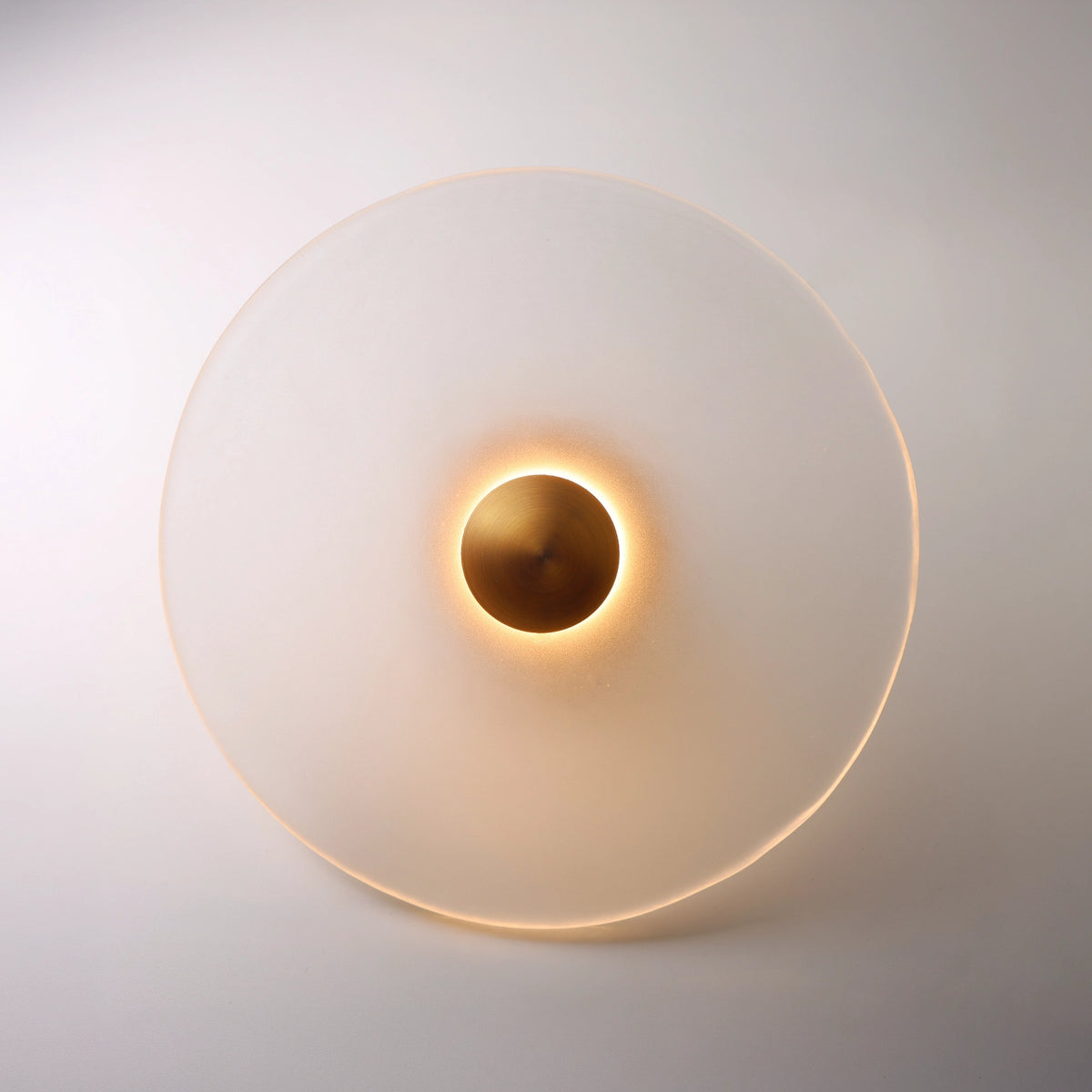
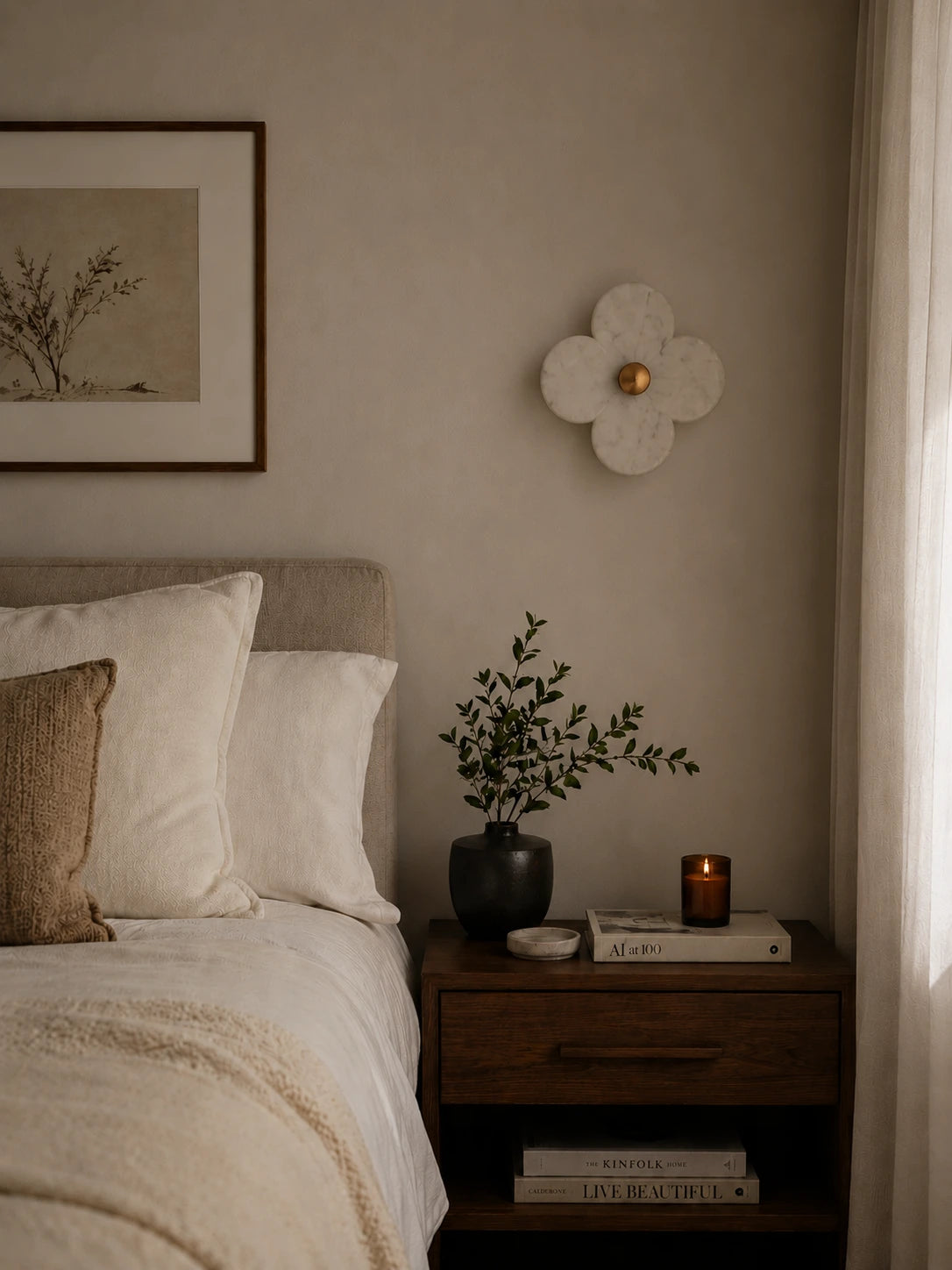
Something that looks good switched off, because it will spend most of the day that way next to a black screen. Natural stone is our first pick here. The Alba is a hand-carved Spanish alabaster disc that glows a warm amber when lit, and it works with dimmer switches, which is what you want for an evening in front of a film. The marble Marquise does a similar job with a more organic shape.
Skip anything too small. A fitting that looks generous in a hallway can disappear beside a 75 inch TV. If you are deciding between two sizes for a big media wall, go with the larger one. Browse the living room wall lights to compare shapes side by side, and see living room wall lighting ideas for how the pair fits with the rest of the room.

Frequently asked questions
Do wall lights either side of a fireplace have to match?
Yes, in almost every room. A fireplace or TV is already a symmetrical focal point, so a mismatched pair looks like a mistake rather than a choice.
Can I have just one wall light next to the TV?
You can, but it tends to look lopsided. If only one side has power, a plug-in fitting or a lamp on the other side will balance it.
Should fireplace wall lights be on the same switch as the downlights?
No. Put them on their own switch, ideally with a dimmer, so you can turn the downlights off and run the room on the pair alone in the evening.
What if the alcoves are different widths?
Centre each fitting in its own alcove and keep the heights identical. The eye notices a height difference far more than a small difference in side spacing.
Can renters add wall lights beside a TV?
Hardwiring needs the landlord's permission and a licensed electrician. Plug-in wall lights with the cord run neatly down the wall are the usual renter option.






0 comments