

Dining room wall lights work best as the second layer, not the main light. Put a pair either side of a sideboard, mirror or artwork, centred about 150 to 165 cm off the floor, use warm 2700K to 3000K globes, and wire them to a dimmer that is separate from the pendant over the table.
That's the short answer. The rest of this guide covers where they go when your room doesn't have a sideboard, what to do when the ceiling point isn't over the table, and which materials look best at dinner time.
Do you need wall lights in a dining room?
You don't strictly need them, but most dining rooms look better with them. A pendant on its own lights the table and leaves the walls dark, so the room shrinks to a bright circle with black edges once the sun goes down.
Wall lights fill in those edges. They also let you turn the pendant right down while you eat, which is when a dining room looks its best. Faces look softer when light comes from more than one direction, and nobody is squinting at a single bright source above the plates.
If you only have budget for one thing, get the pendant right first. Add the wall lights second. Our guide to layering ambient, task and accent light explains why two dimmer sources beat one bright one.
Where should wall lights go in a dining room?
The most reliable spot is either side of a sideboard or buffet. The Lighting Research Center at Rensselaer Polytechnic Institute uses exactly this arrangement in its model dining room design, with a sconce mounted on each side of the buffet and the pendant handling the table.
If there's a mirror or artwork above the sideboard, the lights frame it and the whole wall reads as one composition. No sideboard? These spots also work:
| Spot | Height to centre of fitting | How many | Notes |
|---|---|---|---|
| Either side of a sideboard or buffet | 150 to 165 cm from the floor | A pair | Line up with the outer edges of the sideboard |
| Either side of a mirror or artwork | Near the top third of the piece | A pair | 10 to 20 cm out from the frame |
| Long side wall with no furniture | 160 to 170 cm | Two, evenly spaced | Keep them out of seated eye line |
| Beside a built-in banquette | About 60 to 75 cm above the seat back | One per end | Choose a shade that hides the globe |
| Open-plan dining zone | 160 to 170 cm | One or a pair | Marks the dining area off from the kitchen and lounge |
One spot to avoid: the wall directly behind a seated diner's head at face height. Whoever sits opposite ends up looking straight into a light for the whole meal.
How high should dining room wall lights be?
Centre them around 150 to 165 cm off the finished floor when they flank a sideboard, and 160 to 170 cm on an open side wall. Most sideboards are 80 to 90 cm tall, so the lights end up roughly 60 to 75 cm above the top surface, enough to clear lamps, vases and a fruit bowl.
A dining room is the one room where people spend most of the time sitting down, so check your height from a chair as well as standing up. If you can see the bare globe from your seat, the fitting is too low or the shade is too open. The general rules by room are in how high to hang wall lights.

Can wall lights replace a pendant over the dining table?
Sometimes, and it's a common question when the ceiling point is in the wrong place. Plenty of Australian dining areas, especially in apartments and open-plan builds, have a single light point that doesn't line up with where the table ended up.
Wall lights can carry the room in that case, but only if the table sits against or close to a wall. A pair either side of a table pushed up to a banquette, or along the wall of a narrow dining nook, will light the tabletop well enough to eat by. A table floating in the middle of a big room is too far from any wall, and the centre of the table will feel dim.
For a floating table, the better fix is usually to have an electrician move the ceiling point, then use wall lights for the edges. We compare the two types of fitting more broadly in wall lights vs pendant lights.
What colour temperature and brightness suit a dining room?
Go warm: 2700K to 3000K. Food, timber and skin all look better under warm white, and cool white above 4000K makes a dining room feel like a kitchen at work. Keep every globe in the room at the same colour temperature, including the pendant, or the mismatch shows up on the walls straight away.
Brightness matters less than control. Wall lights in a dining room are there for atmosphere, so a globe of around 400 to 450 lumens per fitting (roughly the old 40 watt) is plenty when the pendant is also on. A dimmer does more for the room than any lumen figure, and our guide to dimming wall lights covers the globes and switches that avoid flicker.
Which wall lights look best in a dining room?
Pick something that glows through its material or bounces light off the wall, rather than a bare globe on a bracket. You'll be looking at these lights from a chair for an hour at a time, so glare matters more here than in a hallway you walk through.
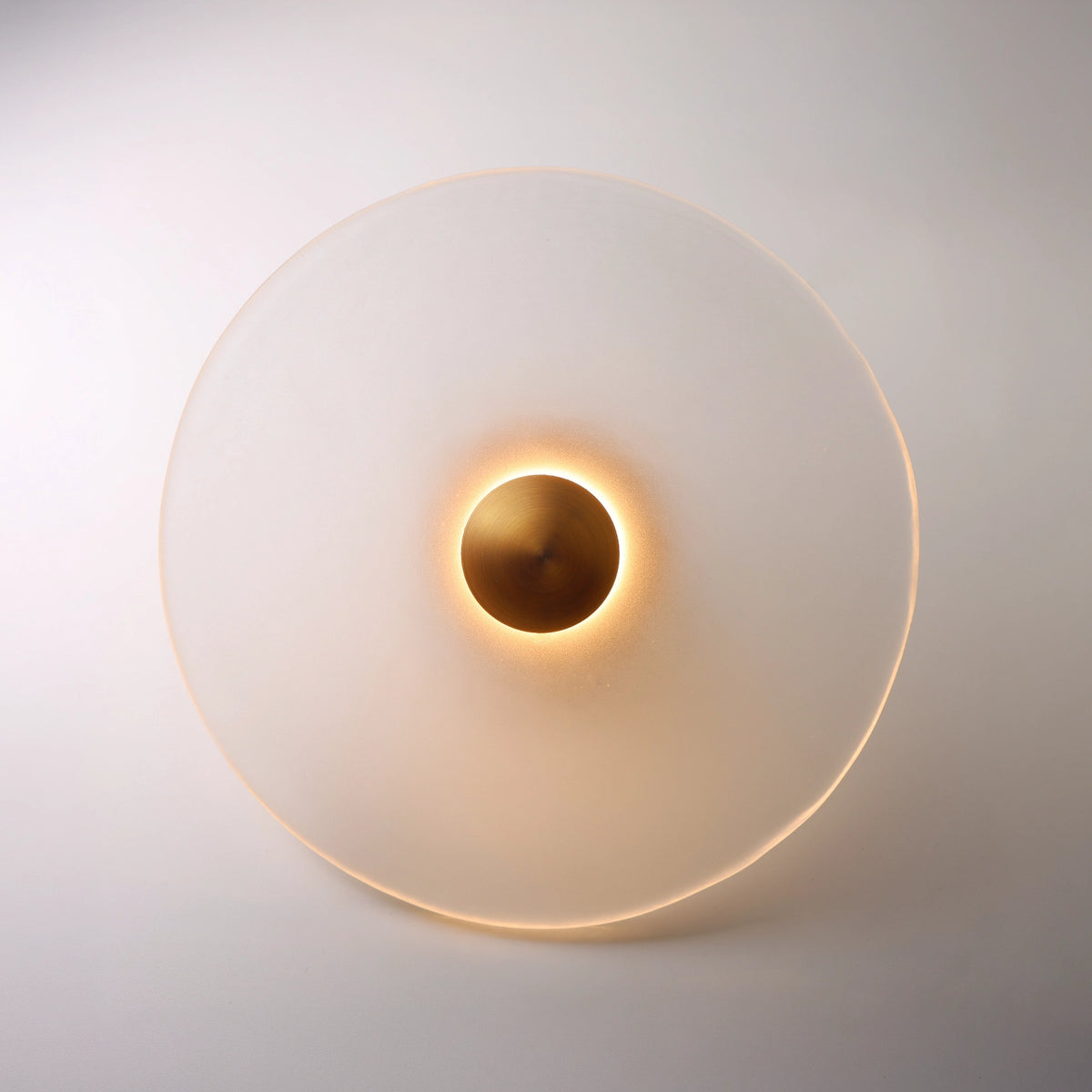
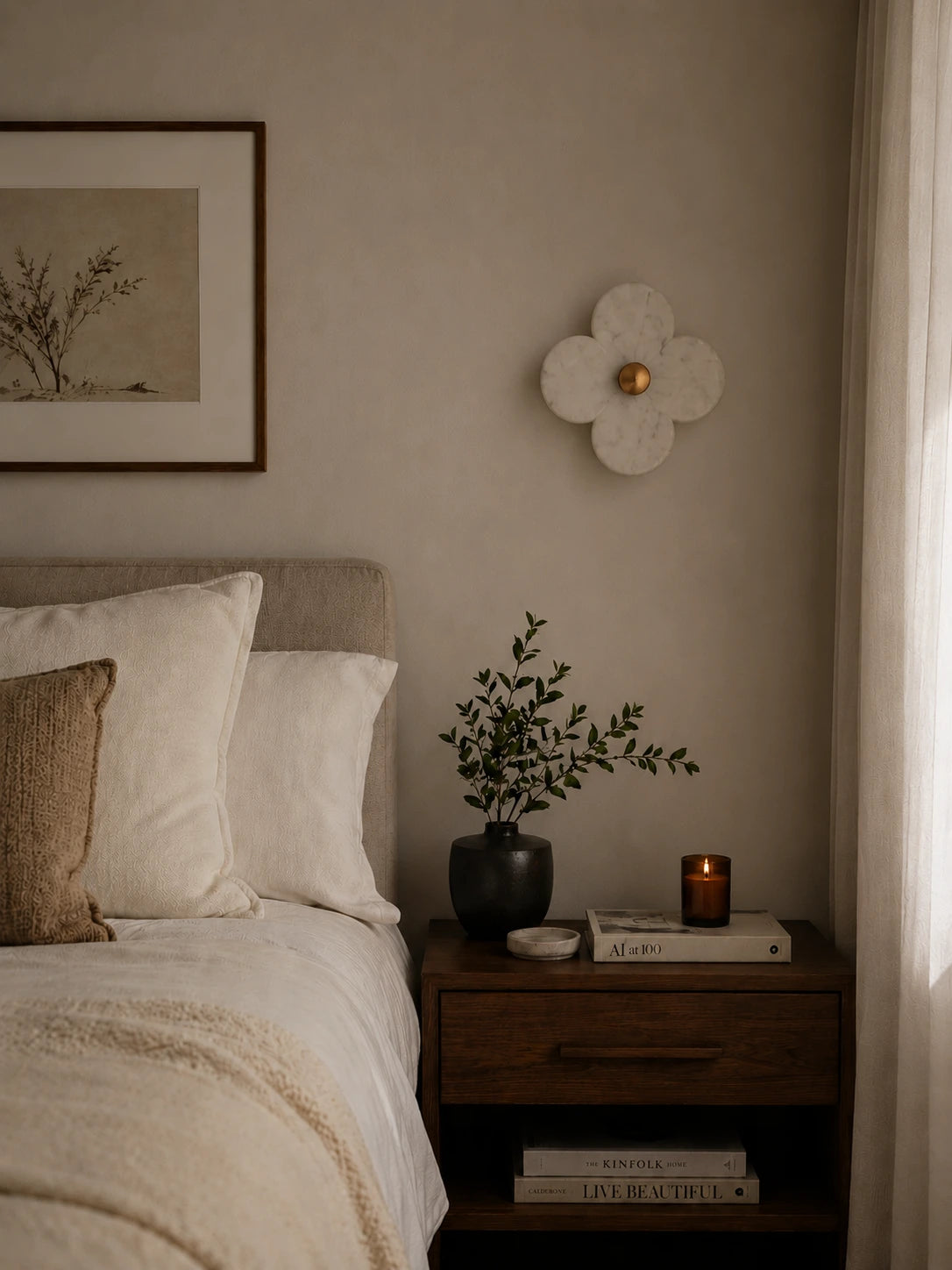
Natural stone is our first pick for dining rooms. Alabaster, travertine and marble all diffuse the light, so the fitting glows rather than shines. The Alba is carved from Spanish alabaster with a brushed brass finish and works with dimmer switches. It looks good on its own and better as a symmetrical pair. The Terra is a plain stone disc with a 3000K glow. See the full natural stone wall lights range.
For a more contemporary room, a slim brass-finish tube like The Aurum throws a focused warm white beam up or down the wall and picks up glassware and cutlery on the table.

A quick note on finishes. A black pendant with brass-finish wall lights is fine. Add a third finish on the chair legs and cabinet handles and it starts to look accidental, so cap it at two.
All Battii wall lights except the outdoor Orb are rated IP20 for dry indoor areas, which is exactly what a dining room is. Hardwired fittings must be installed by a licensed electrician.
Frequently asked questions
Should dining room wall lights match the pendant?
They don't need to match. Pick one shared thread instead, such as the same metal finish or the same colour temperature, so the pendant and wall lights look related without looking like a set.
Do dining room wall lights need to be on a dimmer?
It helps more in a dining room than almost anywhere else. Put the wall lights on their own dimmer, separate from the pendant, and use dimmable LED globes or an integrated fitting rated as dimmable.
How far apart should sconces either side of a sideboard be?
Line each light up with the outer edge of the sideboard, or sit it 10 to 20 cm outside the edge of a mirror or artwork above it. Both lights should be at exactly the same height.
Can I use plug-in wall lights in a dining room?
Yes, if there's a powerpoint near the wall you want to light and you can tidy the cord with a cord cover. Above a sideboard the furniture usually hides most of the cable run.
Do I need an electrician to install dining room wall lights?
For hardwired wall lights, yes. In Australia any fixed wiring has to be done by a licensed electrician, who will work to the AS/NZS 3000 wiring rules.






0 comments