

Wall lights for high ceilings should still be mounted for people, not for the ceiling. In a 2.7 to 3 m room, centre them around 165 to 180 cm off the floor, and stop at about 200 cm even in a double-height void. Choose a larger fitting than usual, ideally one that throws light up and down.
Most height advice assumes a 2.4 m ceiling, which is the minimum the National Construction Code sets for habitable rooms other than kitchens (NCC 2022 Housing Provisions, clause 10.3.1). Plenty of homes go well past that. Think 2.7 m ceilings, raked living areas, and voids that run two storeys above the stairs. Up there the usual rules start to wobble, so here is what changes and what doesn't.
How high should wall lights be in a room with high ceilings?
A little higher than in a standard room, and not much more. The light has to reach the people in the room, and people don't get taller when the ceiling does.
The mistake we see most is splitting the difference between floor and ceiling. Put a sconce halfway up a 4 m wall and it sits at 2 m, above head height, lighting nothing you use. It looks lost on the wall and the room below stays dim. The standard-room numbers are in our guide to how high to hang wall lights. This table extends them upward.
| Ceiling | Centre of fitting from floor | Fitting size (main dimension) | Best light direction |
|---|---|---|---|
| 2.4 m (standard) | 150 to 165 cm | 15 to 25 cm | Any |
| 2.7 m | 160 to 175 cm | 20 to 30 cm | Up and down, or a diffused shade |
| 3 m | 165 to 180 cm | 25 to 35 cm | Up and down |
| 3.5 m and over, or raked | 170 to 200 cm | 30 cm or more, or a matched pair | Up and down |
| Double-height void | Ground floor 170 to 200 cm, upstairs at that floor's eye level | 30 cm or more | Up and down |
Treat these as starting points. Before anyone drills, cut a paper circle the size of the fitting, tape it up, and look at it from the doorway and from the sofa.
Should wall lights shine up or down when the ceiling is tall?
Both, if you can. An up-and-down fitting puts a wash of light on the upper wall, which shows off the height you paid for, and a pool of light below where you actually walk. A downward-only sconce in a tall room leaves the top half of the wall in shadow. At night the ceiling seems to vanish and the room feels like a cave with a very high roof.
The upward half matters most here. Even a modest spread carries a long way up a 3 m wall, and it bounces off a pale ceiling back into the room as soft, indirect light. Under a raked ceiling it traces the slope, which is usually the best thing about the room. There is more on how these fittings behave in up and down wall lights.
Natural stone suits this job. The Luma is an oval travertine LED wall light that washes light up and down the wall, and the Strata pairs travertine with timber accents and lights in both directions too. Both sit in our natural stone wall lights range.

What size wall light suits a high wall?
Bigger than you'd guess. A fitting that looks right on a 2.4 m wall shrinks on a 3.5 m one, because your eye measures it against all the empty plaster above. On a tall feature wall, aim for 30 cm or more in the main dimension, or use a matched pair.
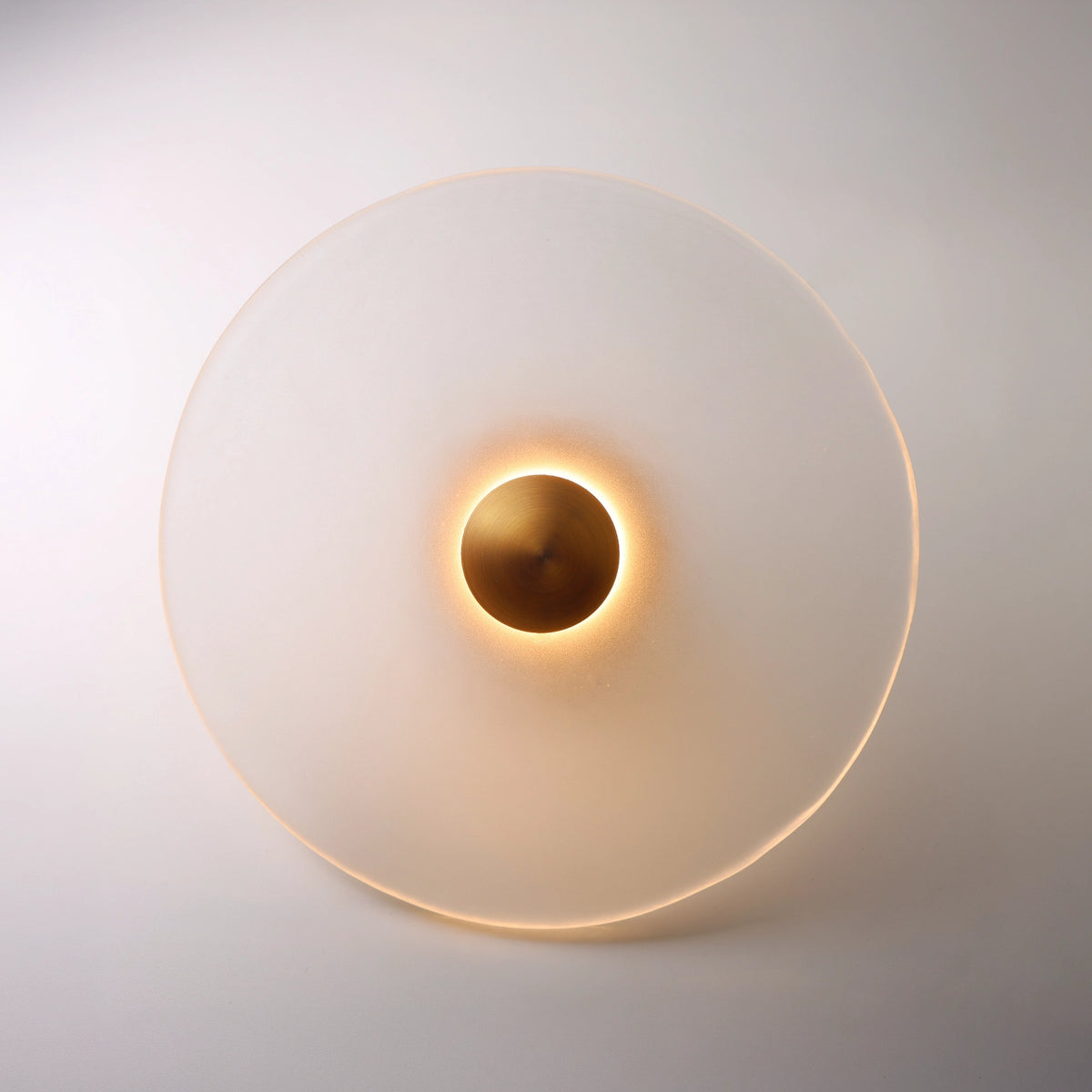
Width isn't the whole story. A fitting with depth and a strong outline holds a big wall better than a thin metal arm with a small shade. A solid stone disc is a good example. The Alba is carved from Spanish alabaster and set on a brushed brass backplate, and it reads as a solid object from across a room rather than a bracket with a glow on the end. It is also compatible with dimmer switches, which you will want in a tall space. The pair that lights a void nicely for a dinner party is far too much at 11pm.

How do you light a double-height void with wall lights?
Use two rows, each set for the floor it serves. Wall lights on the ground floor go at 170 to 200 cm. Lights on the upstairs landing or gallery go at normal eye height for that floor, around 160 cm above the upper floor level. Together they light the void from the bottom and the middle, with nothing hanging in mid-air.
Pendants are the usual answer for voids, and a big one can look great. They are also the hardest light in the house to reach. In a PropertyChat thread about a Sydney void 5.8 m high, the owner's first practical worry was needing a longer ladder. Wall lights mounted off the stairs or the landing avoid most of that problem.
Where a staircase runs through the void, keep each light the same height above its own step so the line follows the stair. Spaced every 2 to 2.5 m, a run up the stair wall lights the treads and the void wall at the same time. Spacing for longer runs is covered in how many wall lights you need.
Where do wall lights go under a raked ceiling?
On one horizontal line, at the height you would use in a 2.7 m room, even where the ceiling climbs. Lights that step up the wall to follow the rake look like they are sliding off it.
On the tall end wall, put a pair either side of a window or fireplace. Their uplight reaches the slope without anything being fixed to the ceiling. One catch: if the raked ceiling is lined in dark timber or painted a deep colour, it soaks up the upward light instead of bouncing it back. You will need brighter globes there, or you accept a moodier room. Neither is wrong.
How do you change a globe three metres up?
You plan for it before the electrician arrives. Anything centred above about 2 m means a step ladder every time a globe goes, and in a void it means a tall ladder on a staircase, which nobody enjoys.
There are two ways around it. Keep fittings within reach of a short step, which the heights in the table already do. Or choose an integrated LED fitting, which has no globe to swap. The trade-off is that when the LED eventually fails, the module or the whole fitting gets replaced. Our integrated LED vs globes guide walks through that choice. For fittings that take a globe, 2700K to 3000K warm white suits tall living spaces, and hardwired wall lights in Australia must be installed by a licensed electrician to the AS/NZS 3000 wiring rules.
Frequently asked questions
Can wall lights be mounted too high?
Yes. Above about 200 cm the light mostly lands on the upper wall and ceiling, the fitting sits above your line of sight, and the room below feels dim.
Are wall lights enough to light a room with a high ceiling?
Not on their own in a main living area. Use them with ceiling lights or a pendant. Wall lights add the middle layer and light the walls, which is what makes a tall room feel finished.
What colour temperature suits a room with high ceilings?
The same as any living space, 2700K to 3000K warm white. Tall rooms can feel cold at night and cooler light makes that worse.
Can I use plug-in wall lights in a room with high ceilings?
Yes, at normal heights. The higher the fitting, the more cord runs down the wall to the powerpoint, so for anything above about 180 cm hardwiring looks far cleaner.
Do I need an electrician to install wall lights in a void?
For hardwired fittings, yes. In Australia a licensed electrician must do the work to the AS/NZS 3000 wiring rules, and in a void they will also need safe access for working at height.






0 comments