

Cylinder wall lights are tube-shaped fittings that sit upright on the wall and send light out of one or both ends, or glow through the body. They project very little, so cylinder wall lights suit hallways, bedside walls and narrow spaces. The material and the light direction decide how one looks when it is switched on.
Plenty of people buy one on looks alone and get a surprise at night. A cylinder that looked like a quiet column in the product photo can throw a sharp stripe up the wall, or barely light anything past its own shade. So start with the light, then pick the finish.
Which way should a cylinder wall light point?
Point it down if you need to see something below it, and choose up and down if you want the wall itself to glow. Up-only is the rarest and the hardest to get right, because all of its light lands on the ceiling.
Here is how the four common types behave on a plain plastered wall.
| Light pattern | What you see on the wall | Best spot | Watch for |
|---|---|---|---|
| Down only | One pool or cone below the fitting | Bedside, stair walls, reading corners | Leaves the ceiling dark, so the room can feel lower |
| Up only | One wash rising to the ceiling | Rooms with ceilings above 2.7 m | On a 2.4 m ceiling the beam hits the plaster as a hard bright patch |
| Up and down | Two cones, one above and one below | Hallways, feature walls, either side of a doorway | Any lump in the plaster shows up in the beam |
| Glowing body | Soft light from the whole shade, little on the wall | Living rooms, bedrooms, anywhere you look straight at the fitting | More decoration than task light |
Up and down cylinders have their own set of rules for spacing and beam angle, which we cover in the guide to up and down wall lights. Down-only and glowing cylinders are a little more forgiving, since there is no upward beam to line up.
Are cylinder wall lights good for narrow hallways?
Yes. A cylinder mounted upright sits close to the wall and takes up very little width, so you are less likely to knock it with a shoulder or a laundry basket in a narrow hallway.
The vertical shape also helps. A row of tall, slim fittings draws your eye up, while a row of wide shades tends to make a corridor feel more cramped. Before you order, check the projection (how far the fitting sticks out) on the product page against the narrowest point of your hallway, including any door that swings past it.
One honest limit: a single cylinder will not light a long hallway on its own. Plan one fitting every 2 to 2.5 metres at the same height. The wall light spacing guide works through the numbers for longer runs.
Ceramic, stone or brass: which cylinder suits your room?
The material changes the light more than people expect. Ceramic and stone hold the light inside and give a soft, low-glare glow. A metal tube sends all of its light out the ends, so the beam on the wall becomes the feature.
Ceramic suits Japandi and minimalist rooms, and it is the safe choice if you are unsure. The Volta is a ceramic cylinder with a frosted glass globe sitting inside it, finished by hand so the glaze varies slightly from one to the next. It comes in four finishes, which helps when you are matching a pair either side of a bed. The Capsule is a simpler ceramic cylinder that throws a warm glow downward.

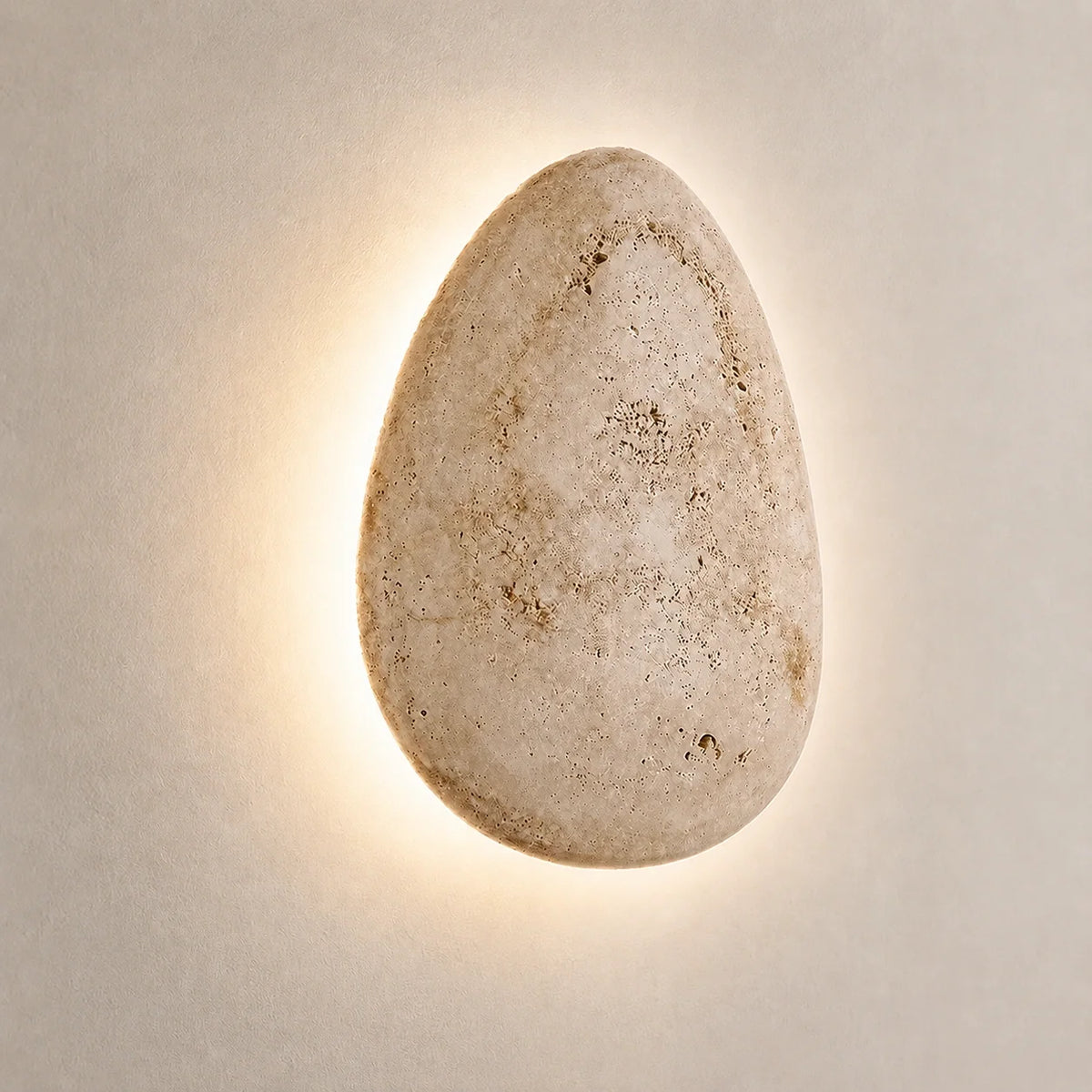
Stone is for organic modern and wabi-sabi rooms, where you want texture you can feel. The Strata pairs natural travertine with timber accents and casts light both up and down. Because travertine is a natural stone, the pitting and colour shift from piece to piece, and that is the point of buying it.
Brass-finish tubes suit contemporary rooms and stair walls. The Aurum is a slim tube in a brass finish that throws a focused warm white glow up or down the wall. It looks best repeated in a vertical run, where the line of light becomes part of the architecture.
If the room already has a lot going on, pick ceramic. If the wall is bare and you want something to look at, pick stone.
How high should cylinder wall lights be mounted?
Centre them about 150 to 165 cm from the finished floor in hallways and living rooms, and about 150 to 160 cm beside a bed. A tall cylinder makes height errors easier to spot, because the top of the fitting is closer to the ceiling than you might think.
Measure to the centre of the fitting, not the bottom. With an up and down or up-only cylinder, leave a generous gap between the top of the fitting and the ceiling. If the top sits close to the cornice, the upward beam lands as a hard bright patch instead of opening out. Our wall light height guide has the figures for every room.
Before the electrician comes, cut a strip of paper to the fitting's real height and width and tape it to the wall. Look at it from the doorway and from the bed or sofa. It takes a minute and it is the easiest way to catch a fitting that is too big for the wall.
Do cylinder wall lights look dated?
The shape itself has been around since mid-century modernism. Vintage dealers still sell brushed aluminium cylinder sconces from that period. What dates is the cheap version: a black aluminium tube with two exposed GU10 globes, the builder-spec version you see on a lot of facades and stairwells.
Ceramic, stone and brass cylinders look nothing like that, because the material is doing the work. A glazed ceramic tube or a travertine column will look as considered in ten years as it does now. Black metal is fine outdoors. Indoors, it can make a room look like a builder's display home.
What globe does a cylinder wall light take?
It depends on the fitting. Some cylinders take a replaceable globe, such as a small G9 or E14 inside a glass diffuser. Others use an integrated LED with no globe to change at all. The product page should say which, and it is worth checking before you buy.
If the fitting takes a globe, use a warm white LED around 2700K to 3000K, and check that it fits inside the shade. A globe that is too long will touch the glass or show as a bright spot. For the trade-offs between the two types, read integrated LED wall lights vs globes.
Battii's cylinders are made for dry indoor areas only. If a fitting is hardwired, a licensed electrician must install it, as the AS/NZS 3000 wiring rules require in Australia. You can see the ceramic options together in ceramic wall lights.
Frequently asked questions
What is a cylinder wall light?
A wall light shaped like a tube that mounts upright and sends light from one or both ends, or glows through its shade. It sits close to the wall, so it suits tight spaces.
Are cylinder wall lights good for bedrooms?
Yes, especially as a matched pair either side of the bed. Choose a down-facing or glowing ceramic cylinder so the light stays soft and out of your eyes when you are lying down.
Can I use a cylinder wall light outdoors?
Only if the fitting has a weather rating for outdoor use. Battii's ceramic, stone and brass cylinders are rated for dry indoor areas only.
How far apart should cylinder wall lights be in a hallway?
About 2 to 2.5 metres apart, all at the same height of around 150 to 165 cm to the centre of the fitting. Much closer and the run reads as one bright band rather than a rhythm.
Do cylinder wall lights make a room look taller?
Up and down or up-only cylinders can, because light on the upper wall and ceiling draws the eye upward. Down-only cylinders do not, as they leave the top of the wall dark.








0 comments