

Good reading nook lighting comes from one wall light set just above and behind your shoulder, about 120 to 140 cm off the floor beside the chair, giving around 400 to 500 lumens of warm white light at 2700K to 3000K. Add a softer light elsewhere in the room so the page isn't the only bright thing you can see.
Where should the light go in a reading nook?
Behind your shoulder and a little to one side. Light from behind lands on the page without bouncing back into your eyes, and coming in from the side means your head doesn't throw a shadow across the text.
Put the light in front of you and you're reading into glare. Put it directly behind your head and you're reading in your own shadow.
The usual mistake is a ceiling downlight dropped over the nook. It looks right on the floor plan. Once you're in the chair, it lights the top of your head while the book sits in the shade of your own face, which is a big part of why we think Australian homes are over-downlit.
How high should a wall light be beside a reading chair?
Lower than anywhere else in the house. For someone sitting down, centre the fitting around 120 to 140 cm off the finished floor, which usually lands it 30 to 40 cm above the top of a standard armchair back. The 150 to 165 cm we suggest in our wall light height guide is for people standing up, and it's too high once you sit.
Seated eye level for most adults is roughly 110 to 120 cm. You want the light a bit above that so the globe stays out of sight when you glance up, but not so high that it's lighting the cornice instead of your book.
Chairs vary more than people think. A deep lounge chair can drop you 10 cm lower than an upright wingback, so test it before anyone drills:
- Sit in the actual chair with a book, in the position you really read in.
- Have someone hold a phone torch against the wall behind your shoulder, starting at about 130 cm.
- Move it up and down until the page is evenly lit and you can't see the light itself without turning your head.
- Mark that spot in pencil, then check it sits 20 to 40 cm out from the side of the chair so the fitting clears your shoulder.
- Give that mark to your electrician.
Which light works best for a reading nook?
A wall light, in most nooks. Here's how the common options compare once you're actually sitting in the chair.
| Light | How it reads | Watch out for |
|---|---|---|
| Wall light behind the shoulder | Even light on the page, takes no floor or table space | Hardwired fittings need a licensed electrician |
| Floor lamp beside the chair | Good, and it moves with the chair | Takes floor space a small nook rarely has |
| Table lamp on a side table | Fine if the shade sits near shoulder height | Most sit too low and light your lap |
| Ceiling downlight overhead | Poor, your head blocks it | Glare when you look up |
How bright should a reading nook light be?
Aim for about 400 to 500 lumens from the reading light itself. That's a touch more than the roughly 400 we suggest in our guide to reading lights for bed, because a chair usually sits further from the wall than a pillow does. Then keep a lower ambient light going somewhere else in the room so you're not reading in a spotlight surrounded by dark.
Age changes the number more than anything else. The Lighting Research Center at Rensselaer Polytechnic Institute, in its lighting guidance for older adults, says task areas need at least three times more light for older eyes to see fine detail. If you're setting up a nook for a parent, or you've started holding the paper at arm's length, go brighter and fit a dimmer.
A dimmer earns its place in a nook anyway. The chair you read in at 8pm is the same chair you sit in with a cup of tea at 10.
What colour light is best for reading?
Warm white, 2700K to 3000K. 2700K feels softer at night, and 3000K keeps text a little crisper if you read for an hour or more. Anything at 4000K or above starts to feel like an office, which is the opposite of what a nook is for.
Colour rendering matters too, especially with cream paper, old paperbacks, or a nook full of timber and linen. A globe rated CRI 90 or higher shows those colours as they are. We explain the number in what CRI means in lighting.
Does a reading light need a shade, or is a bare globe fine?
Get a shade or a diffuser. Sitting down, your eyes are close to the height of the fitting, so a bare globe at 130 cm sits right at the edge of your vision every time you look up. That's glare, and over an hour it wears you out.
Linen and frosted glass both hide the globe and soften the light. Alabaster and marble glow beautifully, but they let less light through, so in a nook they suit the soft background job better than the reading one.

The Veil is the one we'd point most people to. It has a hand-stretched linen shade with antiqued brass detail and a pull-chain switch, which is exactly what you want when the light sits beside your chair and the room switch is over by the door. Reading nooks are one of the spots it was designed for.
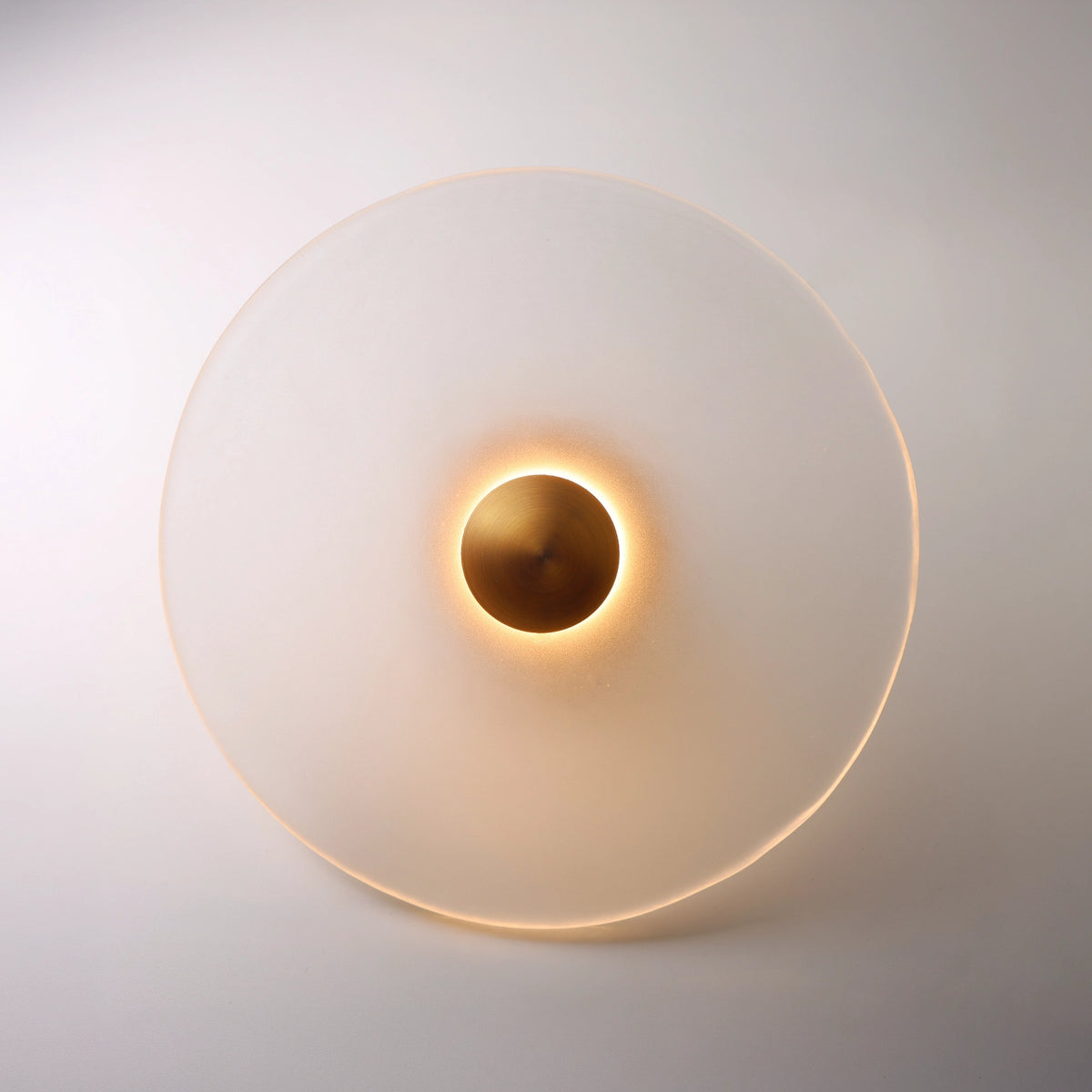
For something flatter on the wall, the Orbis is a mouth-blown frosted glass disc over an integrated LED ring, in 150 mm or 250 mm, so you never see the light source. It's integrated LED, so there's no globe to swap and the light you get is the light it's built with. More choices sit in our living room wall lights range.

Can I add a reading light without rewiring?
Yes. A plug-in wall light runs its cord down to a powerpoint, so there's no electrician involved and very little to patch when you move out. That makes it the usual answer for renters. You'll see the cord on the wall, though a cord cover painted the wall colour hides most of it.
If you'd rather hardwire it, that's licensed work in Australia under the AS/NZS 3000 wiring rules, so a licensed electrician has to do the install. Our plug-in vs hardwired wall lights guide sets out the trade-offs.
Frequently asked questions
Which side of the chair should a reading light go on?
Either side works as long as the light comes from behind your shoulder. If you also write or do crosswords in the chair, put it on the side opposite your writing hand so your hand doesn't shadow the page.
Is a wall light or a floor lamp better for a reading nook?
In a tight nook, a wall light. It frees up the floor, stays at the right height and can't be knocked over. A floor lamp makes more sense if the chair gets moved around the room.
How far from the chair should a reading wall light be?
Mount it 20 to 40 cm out from the side of the chair and roughly in line with the backrest, so the light falls over your shoulder onto the page.
Can one wall light do reading and mood lighting?
Partly. Put it on a dimmer so it can drop back to a low glow when you close the book, and keep a second, softer light elsewhere in the room so the nook isn't the only bright spot.
What LED globe should I use in a reading light?
A warm white LED globe at 2700K to 3000K, around 400 to 500 lumens, with a CRI of 90 or higher. If the light is on a dimmer, the globe has to be marked dimmable.








0 comments