

Mid century wall lights come from roughly the late 1940s to the late 1960s: simple geometric shapes, opal or smoked glass, brass, timber and painted metal, with the light usually softened or aimed rather than left bare. A good one looks like a small object on the wall in daylight and gives warm, low light at night.
That is the look. Getting it right in an Australian house mostly comes down to the shape and the glass, then the globe, and knowing when a vintage find is worth the trouble.
What makes a wall light mid century?
Three things: a clean geometric form, honest materials, and light that is diffused or directed. Decoration comes from the shape itself, never from added ornament.
Think of an opal glass ball on a short brass arm, a painted metal cone tilted toward the wall, or a slim tube that throws light up and down. Mid century designers liked circles, cylinders, cones and starbursts, and they liked you to see what something was made of.
Australia had its own version. Rite Lite, a Melbourne firm established in the early 1950s (per Carters), made wall sconces, pendants and lamps. Its entry on Design and Art Australia Online notes it favoured perforated or painted aluminium shades. Those shades still turn up in vintage shops, and they are a good reference for what local mid century lighting looked like.
Which shapes and materials read as mid century?
Some features say mid century instantly. Others get labelled that way online but belong to another era. Use this as a quick filter when you are scrolling.
| Feature | Reads as mid century | Skip if you want the look |
|---|---|---|
| Shape | Globe, cone, cylinder, disc, sunburst | Scrolls, candle arms, crystal drops |
| Glass | Opal (milky white), frosted, smoked brown or amber | Clear glass with a bare filament globe |
| Metal | Brass, copper tones, painted steel or aluminium | Heavy polished chrome, ornate castings |
| Other materials | Teak or walnut, glazed ceramic | Distressed timber, rope |
| Light | Diffused through glass, or aimed up and down the wall | An exposed globe at eye level |
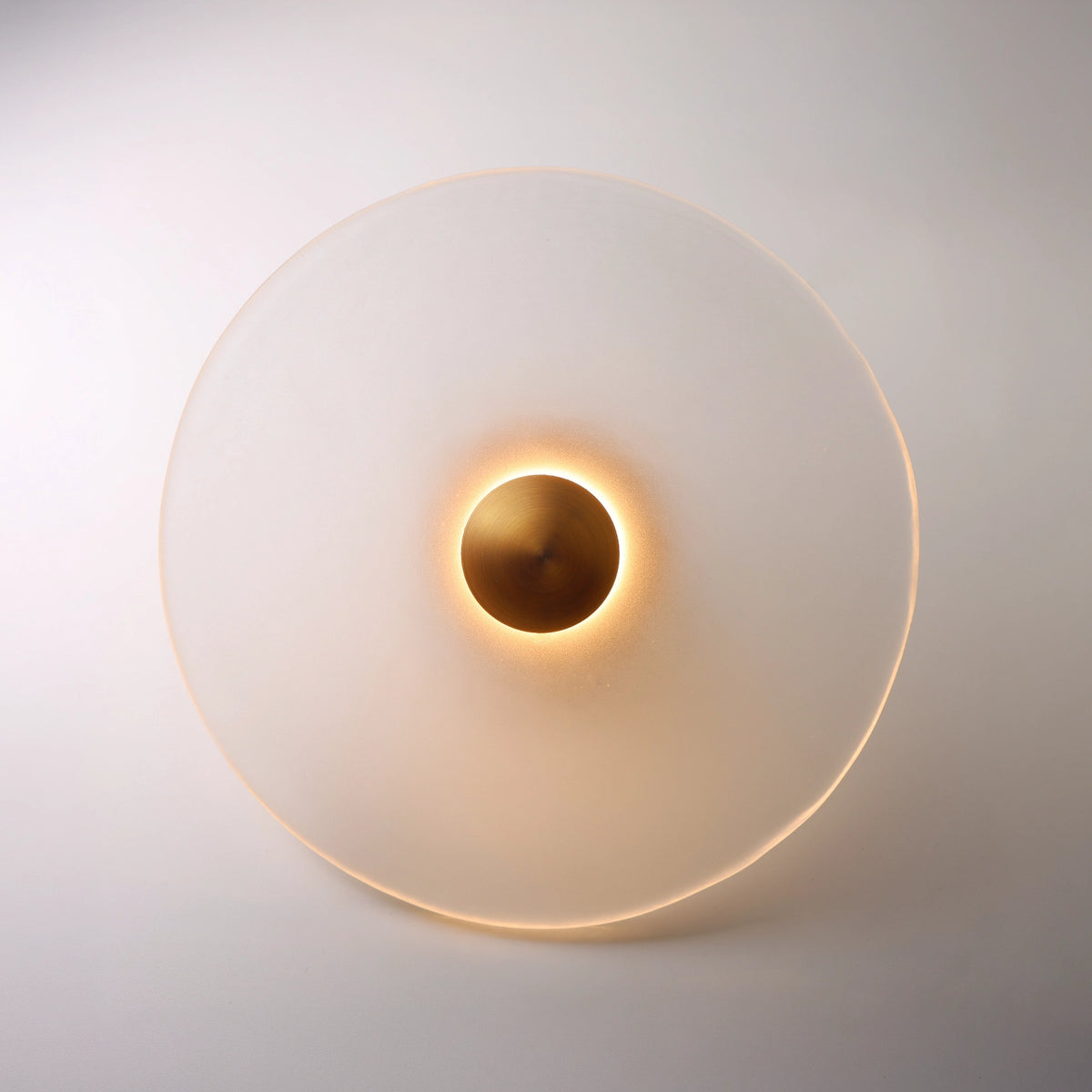
Opal glass is the most reliable cue. It turns a globe into a soft, even ball of light and hides the bulb completely. Smoked brown glass belongs more to the late 1960s and 70s, when interiors went warmer and darker.
If a light is mostly fine geometric lines with stepped or fan details, it is probably art deco, which came a generation earlier. Our art deco wall lights guide covers the differences.

Should you buy vintage or new mid century wall lights?
Buy vintage for a single statement piece you love. Buy new for pairs, runs and anywhere you switch the light on every day.
Original fittings carry real character, but they are 50 to 75 years old. Cords perish, insulation goes brittle, and old sockets were made for incandescent globes. Before a vintage wall light goes on your wall, get a licensed electrician to check it and rewire it if needed. In Australia, any hardwired fitting has to be installed by a licensed electrician under the AS/NZS 3000 wiring rules, vintage or not.
Matching is the other problem. Finding two identical sconces from 1962 for either side of a bed can take months. New designer-inspired fittings solve that, and they take modern LED globes that run cooler than old incandescents and dim properly with the right dimmer.
Where do mid century wall lights work best?
Living room walls, beside the bed, and hallways. They suit the low, horizontal rooms of a 1950s or 60s brick veneer, and the modernist houses architects like Robin Boyd and Harry Seidler designed, but they also sit well in a new build with plain white walls.
- Living room: a single sculptural piece over a sideboard or credenza, centred about 150 to 165 cm from the floor.
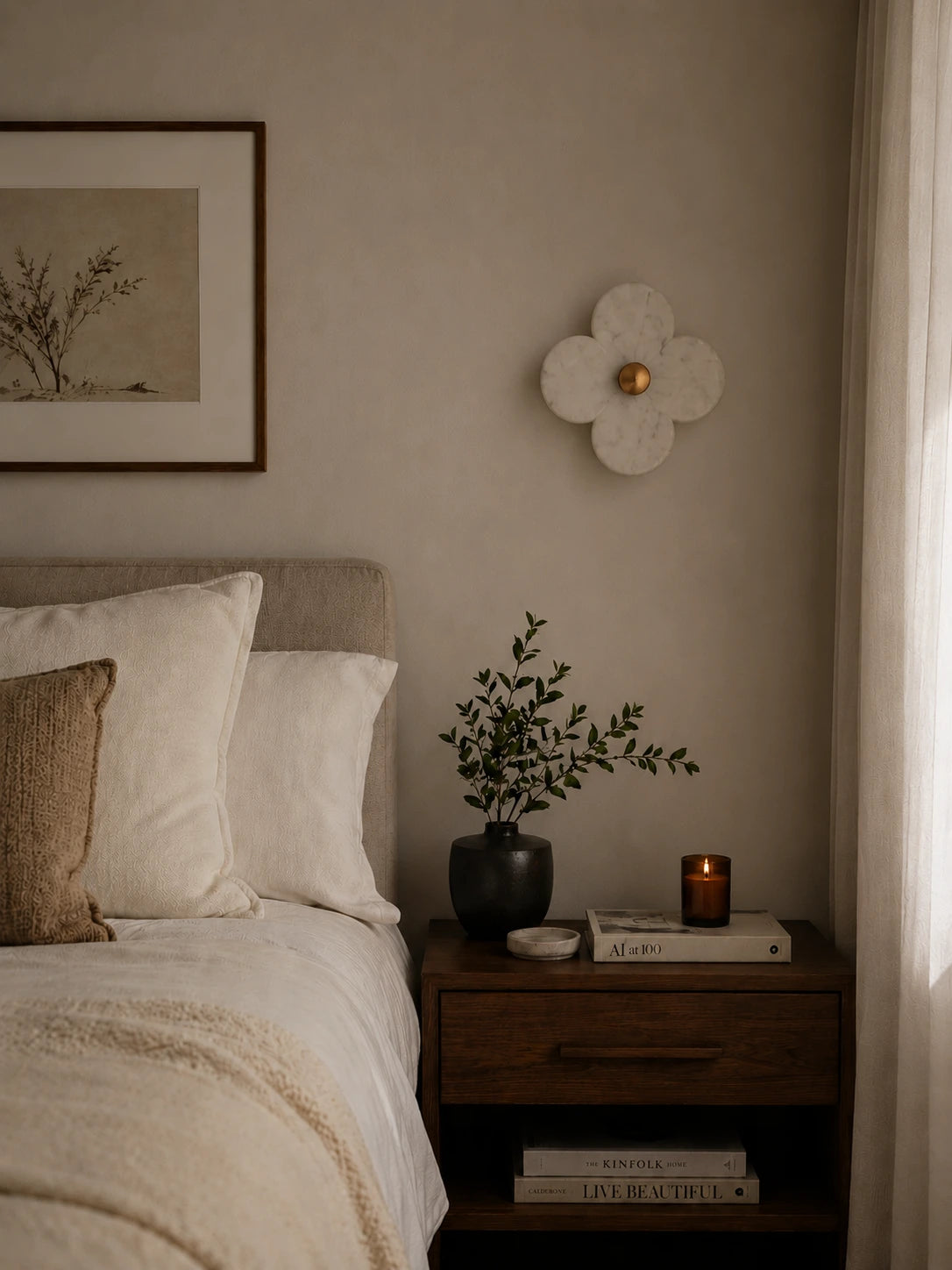
- Bedroom: a matched pair either side of the bed, roughly 25 to 30 cm above the bedside table.
- Hallway: slim tubes or discs repeated every 2 to 2.5 metres at the same height.
The Solara is the closest thing in our range to a classic atomic-era piece: a hand-finished ceramic sunburst around an opal glass globe, in four finishes. For a slimmer line, the Aurum is a brass-finish tube that sends warm white light up or down the wall, which looks right in a hallway run.

What colour temperature suits a mid century room?
Warm white, 2700K for most rooms. Mid century interiors are full of timber, tan leather and mustard or olive fabrics, and cool light (4000K and up) makes all of those look flat and slightly grey.
Coloured glass shifts things further. The Remy takes a 3500K G9 LED, but its smoky brown glass tints the light amber, so it reads warmer on the wall than the number suggests. With opal glass, what you see is close to the globe's own colour, so pick the globe carefully. Our warm white vs cool white guide goes room by room.
Can you mix mid century lights with other styles?
Yes, and most good rooms do. Pure period rooms can feel like a film set. One or two mid century pieces in an otherwise modern house look more deliberate.
The easiest pairing is with organic modern and Japandi interiors, which share the same low furniture, timber and plain walls. Keep the metal finishes in one family (brass with brass, copper with warm bronze), and let the shapes do the talking. If you want more of that calmer look, see our Japandi and wabi-sabi lighting guide, or browse ceramic wall lights, where glazed finishes bridge the two styles.
One thing to avoid: mixing three or four eras of lighting in the same room. A mid century sconce next to an art deco pendant next to an industrial cage light reads as clutter.
Frequently asked questions
What years count as mid century modern?
Roughly the mid 1940s to the end of the 1960s. Some people stretch it into the early 1970s, especially for lighting with smoked or amber glass.
Is opal glass the same as frosted glass?
No. Opal glass is milky white all the way through and gives a very even glow. Frosted glass is clear glass with a roughened or etched surface, so it diffuses light but looks slightly more see-through.
Can I put an LED globe in a vintage wall light?
Usually, if the socket matches the globe and the fitting is in safe condition. Have a licensed electrician check and rewire old fittings before they are installed.
Are mid century wall lights suitable for bathrooms?
Only if the product is rated for that zone. Our indoor wall lights are rated IP20, which means dry indoor areas only, so keep them out of bathroom wet zones.
Do brass mid century lights go out of style?
Brass has been in and out of fashion since the 1950s, but warm metal with opal or smoked glass keeps coming back. Choose a shape you like rather than chasing the finish of the year.






0 comments