

Art deco wall lights are fittings built on symmetry and strong geometry, such as stepped, fan or sunburst shapes, with the light softened through frosted, opal or tinted glass instead of a bare globe. In an Australian home they look best in matched pairs, running warm 2700K globes, against an otherwise calm room.
What makes a wall light art deco?
Mostly it comes down to shape, and to what the light shines through.
Deco design leans on straight lines, stepped forms, chevrons, fans and sunbursts, and on stylised flowers rather than realistic ones. A deco sconce is usually symmetrical left to right, so a pair looks like a mirror image. The light itself is almost never bare. It comes through frosted, opal or tinted glass, or through stone such as alabaster, which is why old deco fittings throw a soft, even glow instead of a sharp beam.
Metal matters too. The original period loved chrome plating and polished or antique brass, often against black. If a light has a clean geometric outline, a diffused glow and a bit of shine on the hardware, it will read as deco even if it was made last year.
What doesn't make a light deco: an Edison filament globe on a bare cage. That is industrial styling, a different look entirely, even though it often gets tagged as deco online.
Where did art deco lighting come from?
The name comes from the 1925 Exposition internationale des arts décoratifs et industriels modernes in Paris, a show that ran from April to October and required every exhibit to be modern. The label "art deco" itself only stuck decades later, after a 1966 exhibition in Paris and Bevis Hillier's 1968 book on the style.
The style peaked from the 1920s into the early 1930s, then got sleeker. By around 1930 designers inspired by ocean liners, cars and airships had moved toward Streamline Moderne, with rounded corners and smooth, polished surfaces.
Australia picked it up in the interwar years. Sydney's Potts Point and Elizabeth Bay are still lined with deco and moderne flat buildings from that time, and plenty of interwar houses and flats around the country have the original features that make a deco wall light feel at home rather than borrowed.
Art deco or Streamline Moderne: what's the difference?
They get sold under the same tag, but they look different on a wall. Knowing which one you want narrows the search fast.
| Feature | Classic art deco (1920s) | Streamline Moderne (1930s) |
|---|---|---|
| Outline | Stepped, angular, fan or sunburst | Rounded, curved, horizontal bands |
| Ornament | Chevrons, zigzags, stylised flowers | Very little, the shape does the work |
| Glass | Frosted, etched or opal panels | Smooth opal or frosted domes and discs |
| Metal | Brass, chrome, often with black | Polished chrome and nickel |
| Best in | Dining rooms, entries, feature walls | Hallways, bedrooms, entries |
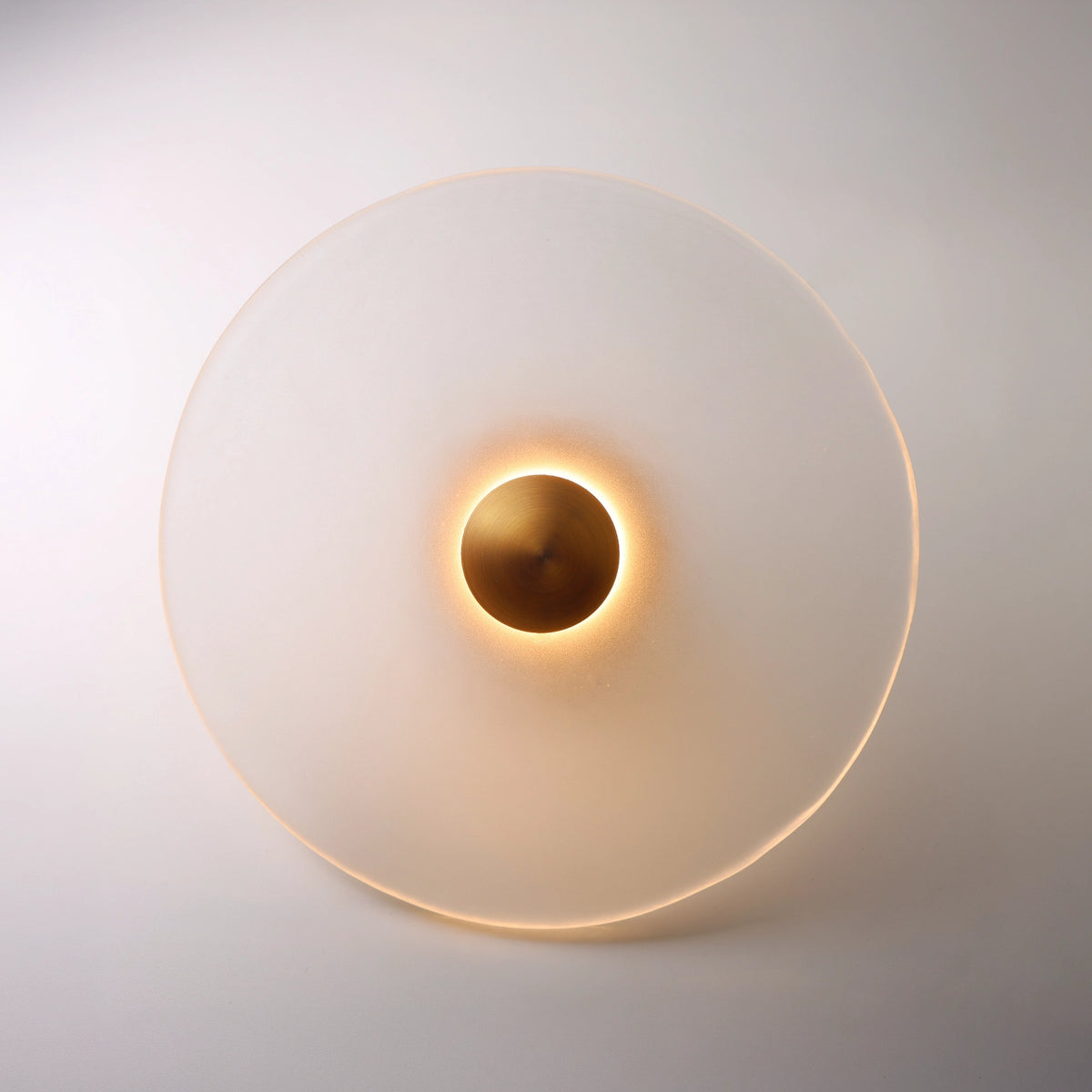
A frosted glass disc on a metal backplate is the simplest version of the moderne idea. Our Orbis sits in that family: a hand-blown frosted glass disc lit by a hidden LED ring, on a brass, bronze or nickel backplate. We sell it as a contemporary light, but put a pair in an interwar hallway and it looks like it has always been there.
Do art deco wall lights suit a modern Australian home?
Yes, and they often work better in a new build than a full period fit-out does. One strong deco piece reads as a choice. A whole room of deco reproductions reads as a set.
Our view: let the wall lights carry the period reference and keep everything else around them quiet. Plain walls and simple joinery, plus maybe one other nod to the era in the mirror or the door hardware. Deco wall lights are good at this because they are small and sit at eye level, where you notice them most.
If you want warmth more than glamour, go for tinted glass and copper tones over chrome. The Remy pairs a copper-tone body with smoky brown glass over a G9 LED at 3500K. Up close it looks like a piece of vintage jewellery, and across the room it reads as an amber glow.

The sunburst is the other deco motif that crosses over well. The Solara sets an opal glass globe inside a handmade ceramic sunburst, so you get the period shape in a softer, matte material. Stone works the same way. Alabaster turns up in deco lighting too, and our alabaster guide explains why it glows the way it does.
Which globe should go in an art deco wall light?
A warm white LED globe of around 2700K, frosted or opal rather than clear, and dimmable if the circuit has a dimmer. That gets you closest to the soft, slightly golden light these fittings were designed around.
Clear filament globes look great in photos but can show a bright point through thin frosted glass. Under an opal or alabaster shade the difference is small, so pick on colour temperature first. Cool white (4000K and up) flattens brass and makes chrome look clinical. Our warm white vs cool white guide goes room by room.
Check the cap before you buy. Australian homes mostly use B22 bayonet and E27 or E14 screw globes, and many smaller fittings take a G9 capsule. The globe type guide shows how to tell them apart.
How do you hang art deco wall lights so they look right?
Symmetry is the whole point of the style, so placement matters more than with most fittings.
- Buy in pairs. Flank something: a bed, a mirror, a sideboard, a doorway or a fireplace.
- Centre the pair on the object, not the wall. Measure from the middle of the mirror or bed outwards so both lights sit the same distance from it.
- Keep both fittings at exactly the same height. A 10 mm difference shows on a symmetrical design in a way it wouldn't on an organic one.
- Check the outline from the doorway. Stepped and fan shapes have a clear top and bottom, so make sure they are mounted the right way up before the plaster is patched.
- Get a licensed electrician to install hardwired fittings. In Australia that work must be done to the AS/NZS 3000 wiring rules.
For exact heights by room, use our wall light height guide. For more frosted, opal and tinted options, browse the glass wall lights collection.

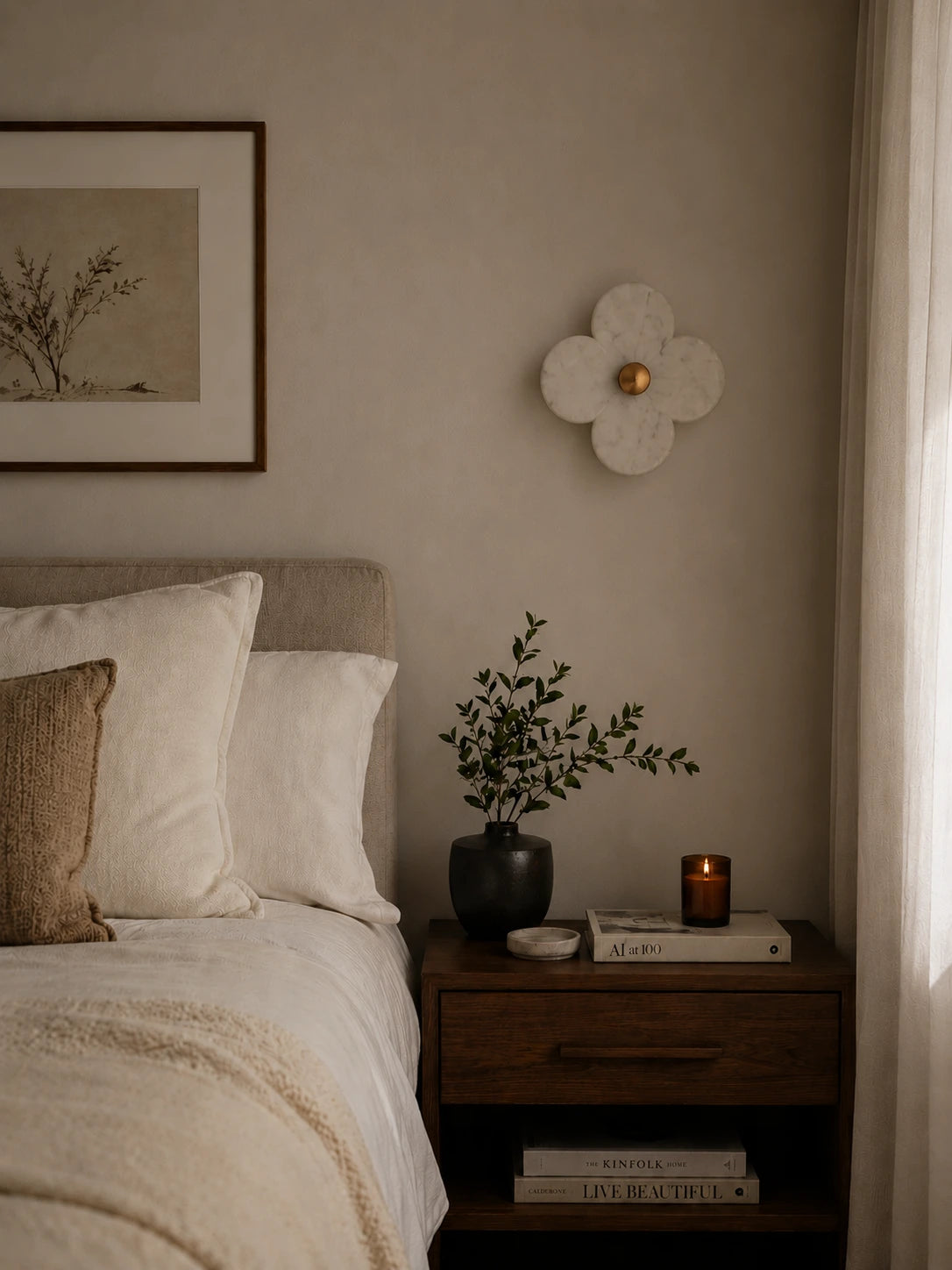
If you like stylised flowers, the Petalo is hand-carved Spanish alabaster cut into four petals on a brushed brass backplate. It is a modern piece, but the stylised flower and the stone-and-brass pairing both feel very interwar.
Frequently asked questions
Is art deco lighting back in style?
It never fully left, but deco-inspired wall lights are common again in Australian renovations. The versions that age well use one or two period cues rather than copying an original line for line.
Is brass or chrome more art deco?
Both are correct. Brass and black suit the earlier, more ornamental deco look, while polished chrome and nickel suit the smoother Streamline Moderne style of the 1930s.
Can I mix art deco wall lights with a modern pendant?
Yes. Match one thing, such as the metal finish or the glass type, and let the shapes differ. Two strong period pieces in one room usually fight each other.
Are original vintage art deco wall lights safe to use?
Many are close to a century old, and the wiring often is too. Have a licensed electrician check and rewire any vintage fitting before it goes on an Australian 230V circuit.
Can art deco wall lights go in a bathroom?
Only if the fitting carries an IP rating suited to that bathroom zone. Most decorative indoor wall lights, including ours, are rated IP20 and belong in dry rooms only.






0 comments